
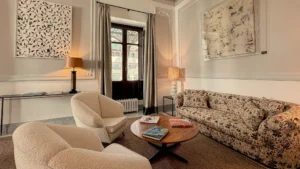
Madrid, Granada, and Córdoba are the stage for a new way of understanding luxury: historic hotels, contemporary design, and art coexist to create stays that go far beyond accommodation.
What happens when sleeping in a hotel also becomes a way to discover art, architecture, and history?
At Hospes Hotels, the answer can be found in three of our most emblematic properties: Hospes Puerta de Alcalá, Hospes Palacio de los Patos, and Hospes Palacio del Bailío. After their recent renovations, these hotels embark on a new stage where heritage, contemporary interior design, and prominent art collections are part of the same experience.
Here, art does not simply function as decoration. It integrates into the hotel’s everyday life and appears in receptions, lounges, stairs, hallways, restaurants, and rooms. The guest discovers it while exploring the building, without the need to follow an itinerary.
The result is a new idea of cultural luxury in Spain: more personal, more connected to each destination, and designed to be enjoyed unhurriedly.
Hospes Puerta de Alcalá: contemporary art in a noble house in Madrid
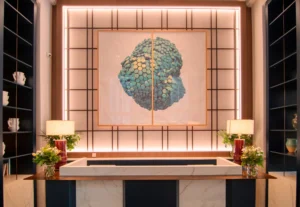
Facing the Puerta de Alcalá and next to El Retiro, Hospes Puerta de Alcalá occupies a residence from 1883 designed by José María de Aguilar.
Its recent renovation, signed by Tomás Alía and Estudio Caramba, recovers the spirit of the great residences of Madrid’s bourgeoisie of the 19th century and interprets it from a contemporary perspective.
The main floor abandons the traditional lobby concept to become a succession of connected rooms, intimate lounges, and gathering spaces. Veined stone, wood, natural fibers, and domestic character lighting create the sensation of entering a sophisticated private residence.
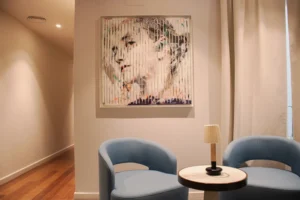
In this setting, art takes on a special prominence. Works by Manuel Rivera, Antoni Tàpies, Los Carpinteros, Liza Lou, and Lita Cabellut, among other artists, are part of the guest’s journey and establish a dialogue between Spanish post-war abstraction and various expressions of international contemporary art.
The experience continues in the rooms and suites, as well as in Malvar de Ultramar, its restaurant and terrace overlooking the Plaza de la Independencia, the interior garden, and Bodyna Spa, located in the old building stables.
Madrid is thus discovered from a new perspective: living art within a historic house in one of the city’s most emblematic locations.
Hospes Palacio de los Patos: a Granada palace turned into a cultural space
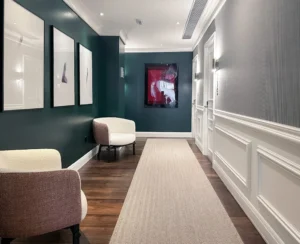
In the heart of Granada, Hospes Palacio de los Patos combines two seemingly different architectures: a neoclassical palace from the 19th century and the contemporary Alabaster Building.
After its recent renovation, the interior design project, led by Bárbara Chapartegui alongside Alex Briones, enhances the original elements of the palace and combines them with neutral and warm tones, highly tactile fabrics, sculptural lighting, and specially selected furniture to create a contemporary and welcoming atmosphere.
Art is present throughout the hotel. The reception, the library, the monumental staircase, the restaurant, the lounges, and the rooms become stages to discover a collection that brings together names like Lucio Muñoz, Christopher Wool, Eduardo Arroyo, Marta Gómez de la Serna, Cecilia Sebastián de Erice, Adolfo Estrada, Beatrice Caracciolo, and Monsa Domingo.
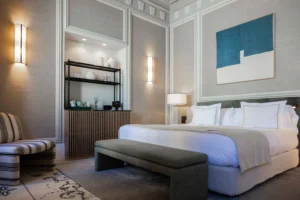
Prominent pieces include Desholínador, by Eduardo Arroyo; Jardín romano, by Marta Gómez de la Serna; Untitled, by Christopher Wool; and Composición vertical, by Lucio Muñoz.
The artworks interact with mosaics, ornate ceilings, and other historical elements of the palace, while the Alabaster Building contributes glass, light, and contemporary geometries.
The renovation is completed with the garden-terrace of Restaurante Los Patos and Bodyna Spa, creating a luxury retreat from which to explore Granada and its extraordinary cultural heritage.
Hospes Palacio del Bailío: art, history, and Roman remnants in Córdoba
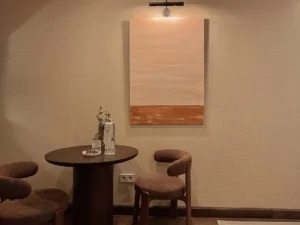
In Córdoba, Hospes Palacio del Bailío takes the dialogue between past and present even further.
The hotel occupies a set of buildings constructed between the 16th and 18th centuries. Beneath them lie Roman remains that can be seen through the glass floor of its central courtyard.
Historical paintings, original architectural elements, and restored frescoes run throughout the building. Some of these pieces turn the Grand Captain Presidential Suite and the Historic Junior Suites into authentic inhabitable works of art.
The recent renovation, signed by Bárbara Chapartegui and Tristán Domecq, incorporates natural oak, travertine, aged brass, and noble fabrics. The palette, inspired by lime white, linen, olive green, and terracotta, establishes a new balance between historic architecture and contemporary design.
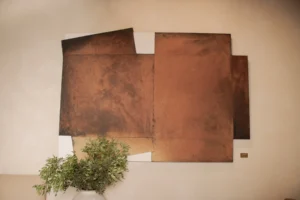
This stage showcases a collection of artists such as Rafael Canogar, Antonio Saura, Carmen Laffón, Gonzalo Lebrija, José Dávila, Elena Alonso, Pin Morales, and Manuel Padorno.
The artworks appear from the entrance and reception to the corridors and rooms. There is no imposed route: each guest discovers them at their own pace while inhabiting the palace.
The experience extends to gastronomy, with Restaurant Arbequina, led by chef Rubén González, and to Bodyna Spa, where the extraordinary Roman baths recover another of the great historical traces of the building: the millenary tradition of bathing.
Three cities, three historic hotels, and a new way of understanding luxury
Madrid, Granada, and Córdoba offer three radically different scenarios. However, Hospes Puerta de Alcalá, Hospes Palacio de los Patos, and Hospes Palacio del Bailío share the same philosophy.
Contemporary luxury resides not only in what is seen, but also in what is experienced.
Sleeping next to a work of art. Discovering a historic fresco inside a suite. Crossing the archaeological remains of a Roman city. Walking through a neoclassical palace. Sitting in a room designed like that of a private residence.
These are experiences that transform a stay into more than just accommodation.
With these three renovations, Hospes Hotels reaffirms the unique character of its properties and celebrates the hotel as a meeting point between hospitality, architecture, design, art, and culture.
Three historic hotels. Three Spanish cities. One invitation: discover the art of living.